
EUR/USD Weekly Forecast: Fed calm, ECB steady, but the Dollar still leads
- Feb 28
- 4 min read


EUR/USD maintains its erratic performance around the 1.1800 region.
The US Dollar weakens modestly amid trade uncertainty and geopolitical tensions.
Investors' attention now shifts to next week's US labour market report.
Inflation in Germany is seen easing a tad in February, as per preliminary data.
EUR/USD is still struggling to find real traction. The pair has tried to stabilise, but momentum keeps fading, leaving the door open to further weakness. If sellers manage a convincing break below the monthly floor near 1.1740, the spotlight would quickly shift to the critical 200-day Simple Moving Average (SMA).
By the end of the week, EUR/USD is nursing only marginal gains. The 1.1800 barrier remains stubbornly out of reach, and that inability to break higher tells its own story.
|premium|
02/27/2026 16:17:07 GMT
EUR/USD Weekly Forecast: Fed calm, ECB steady, but the Dollar still leads
EUR/USD maintains its erratic performance around the 1.1800 region.
The US Dollar weakens modestly amid trade uncertainty and geopolitical tensions.
Investors' attention now shifts to next week's US labour market report.
Inflation in Germany is seen easing a tad in February, as per preliminary data.
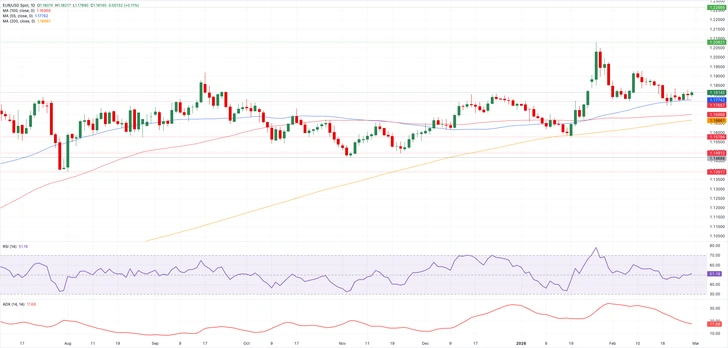
EUR/USD is still struggling to find real traction. The pair has tried to stabilise, but momentum keeps fading, leaving the door open to further weakness. If sellers manage a convincing break below the monthly floor near 1.1740, the spotlight would quickly shift to the critical 200-day Simple Moving Average (SMA).
By the end of the week, EUR/USD is nursing only marginal gains. The 1.1800 barrier remains stubbornly out of reach, and that inability to break higher tells its own story.
The choppy price action fits the broader mood across global markets. There has been no clear direction, just a steady digestion of last week’s US Supreme Court ruling against President Trump’s global tariffs. Add renewed trade uncertainty and rising geopolitical tensions in the Middle East, with Washington and Tehran back in a verbal standoff, and it is hardly surprising that conviction has been limited.
In this environment, assets have been drifting rather than trending.
ECB: confident, but not complacent
The European Central Bank also left rate unchanged, in a unanimous and widely anticipated decision.
The message was disciplined. Inflation is still projected to return to the 2% target over the medium term. Wage pressures are stabilising, services inflation remains under close scrutiny, and a modest dip in prices is expected in 2026.
The key moment this week was Christine Lagarde’s testimony before the European Parliament. She sounded confident but cautious. Inflation, she insisted, is on track to return to 2% over time, with food price pressures gradually easing into 2026. She highlighted support from solid wage growth, a resilient labour market and firmer investment. At the same time, she reiterated that the ECB monitors the euro but does not target it and noted there are no visible signs yet of AI-driven job losses.
The takeaway is straightforward: the ECB feels policy is well calibrated but remains fully data dependent and ready to adjust if needed.
On the inflation front, preliminary figures from Germany point to Consumer Price Index (CPI) growth of 1.9% YoY in February, slightly below the 2.0% recorded at the start of the year. A gentle cooling, but nothing dramatic.
Positioning: conviction on both sides
Positioning data tell an interesting story. Speculative net longs in the euro have climbed to their highest levels since 2020. At the same time, short positions have also risen sharply.
When both sides increase exposure simultaneously, it signals conviction and tension, not a one-way bet.
Open interest remains elevated. This is not a thin, illiquid move. It is a proper battle.
Net positioning still favours the euro overall, but the build-up in opposing shorts makes the upside more fragile and highly sensitive to incoming macro surprises.
Near-term drivers: the Dollar still sets the pace
In the short-term horizon, the US Dollar continues to set the tone. Trade headlines and geopolitical developments are adding noise, and the relative quiet from the ECB is doing little to shift the balance.
The risk scenario is clear. If the FED maintains its cautious stance and US data remain firm, the Dollar keeps a natural floor. A decisive break below the 200-day SMA would materially weaken the technical picture and increase the probability of a deeper correction.
Technical corner
In the daily chart, EUR/USD trades at 1.1815. The near-term bias is mildly bullish as spot holds above the rising 55- and 100-day Simple Moving Averages (SMAs), which trade just below 1.1800 and cluster well above the 200-day SMA near 1.1700, indicating an underlying upward trend structure. Price action has been consolidating after the late advance, but the Relative Strength Index (RSI) around 51 stays marginally above its midline, suggesting buyers retain a slight momentum edge despite the waning Average Directional Index (ADX), which points to a loss of trend strength rather than a reversal.
Immediate support emerges at 1.1766, where horizontal support aligns beneath spot and coincides with the nearby SMAs, and a break below this area would expose the next downside level at 1.1578. On the upside, initial resistance is seen at 1.2082, the first marked horizontal barrier above the market, with a continuation higher targeting 1.2266 and then 1.2350. As long as EUR/USD defends 1.1766 on daily closes, the path of least resistance favours further tests of overhead resistance, while a sustained move below that level would shift the focus back toward the broader support band starting near 1.1578.


Comments